

When you were in school, you probably learned your multiplication facts in order. First all the x 1 facts. Then all the x 2 facts. Next, the x 3 facts, and so on. And maybe that's the way you've taught it in your homeschool, too. There's nothing wrong with that approach, but I want to suggest a new method that might help change things up if you or your kiddos feel stuck on the multiplication facts!
Create Your Own Multiplication Chart
Sometimes homeschool parents hang out in the chapter of the math curriculum that teaches multiplication facts because they believe students have to have all the facts memorized before they can move on. Multiplication speed and fluency is certainly helpful when it comes to completing more complex math problems. But not all students are going to memorize math facts well.
Some students learn better by using the facts than by memorizing them in the abstract. So, how do you move on to more complex math before your students have memorized all the basic facts? You use a multiplication chart!
If students can create their own multiplication chart, then they understand the concept of multiplication and how to figure out the answers. By using a self-generated multiplication chart, they can use their own knowledge more quickly when calculating area or completing long multiplication.

Start with the Easiest Problems
That big empty multiplication chart above has 144 empty boxes. It may seem a daunting task - for you or for your student - to fill them all in. But if we break it down into simple steps, you'd be surprised how quickly the chart can be completed!
The Identity Property of Multiplication
Your students probably already know that multiplying anything by one equals the number you started with. You can tell them that the fancy term for this is the "Identity Property of Multiplication". Using this rule, they can easily fill in the x 1 row and column on the multiplication chart.
Doubles from Addition Facts
If your student explored "doubles" (4 + 4, 7 + 7, etc.) when he was learning addition facts, they he already knows the x 2 multiplication facts! Alternatively, most students can count by 2s and recognize the pattern of even numbers. You can use either of these strategies to help your student fill in the x 2 row and column on the multiplication chart.
Nickeling and Diming the x 5 and x 10 Facts
When students learn to count money, the count nickels by fives and dimes by tens. You can use these same skills for the x 5 and x 10 rows and columns. You can even pull out your real or play money to help them visualize the concept of multiplying by 5 and 10.
At this point, your student has completed all of the green squares on the multiplication chart! Look how quickly it is filling up!

Teach Two Fun Multiplication Tricks
Next, you can teach your students two cool multiplication hacks they'll enjoy using to fill in the chart and even to solve problems they encounter in later math.
Multiplying x 9 on Your Fingers
When you add ten to a number, the tens place increases by one, but the ones place stays the same (example: 33 + 10 = 43). Nine is almost ten, but not quite. When you add nine, the tens place increases by one, but the ones place decreases by one. For example, 27 + 9 = 36.
This means that when you multiply nine by anything between one and nine, the two digits will always add up to nine! The tens place keeps increasing by one, but the ones place goes down by the same amount, so the sum of the two digits stays the same!
This also means that you can use a cool finger trick to multiply by nines up through 9 x 10.
Place both hands flat on the desk or table. Starting with the pinky of your left hand and counting across to the pinky of your right hand, each finger has a number 1 - 10.
Find the finger that corresponds with the number you are multiplying by 9. Tuck that finger under your hand.
The fingers remaining to the left of the tucked finger represent the tens place of the answer. The fingers remaining to the right of the tucked finger represent the ones place!
Elevens Facts are Palindromes
A palindrome is a word, phrase, or number that reads the same forwards or backwards. Here are some examples:
wow
taco cat
123,321
The first twelve multiples of eleven are all palindromes, too! Why? Because eleven is a palindrome (both digits are the same). And when you add eleven to a number both the ones place and the tens place increase by one, so all multiples of eleven through x 9 have two identical digits.
Note: If you want to take this a step further, you can teach your kids the trick to multiplying eleven by a two-digit number. The tens place of the two-digit number becomes the hundreds place of the answer. The ones digit remains in the ones place. And then the sum of the two digits becomes the tens place. Like this:
11 x 11 = 121
11 x 12 = 132
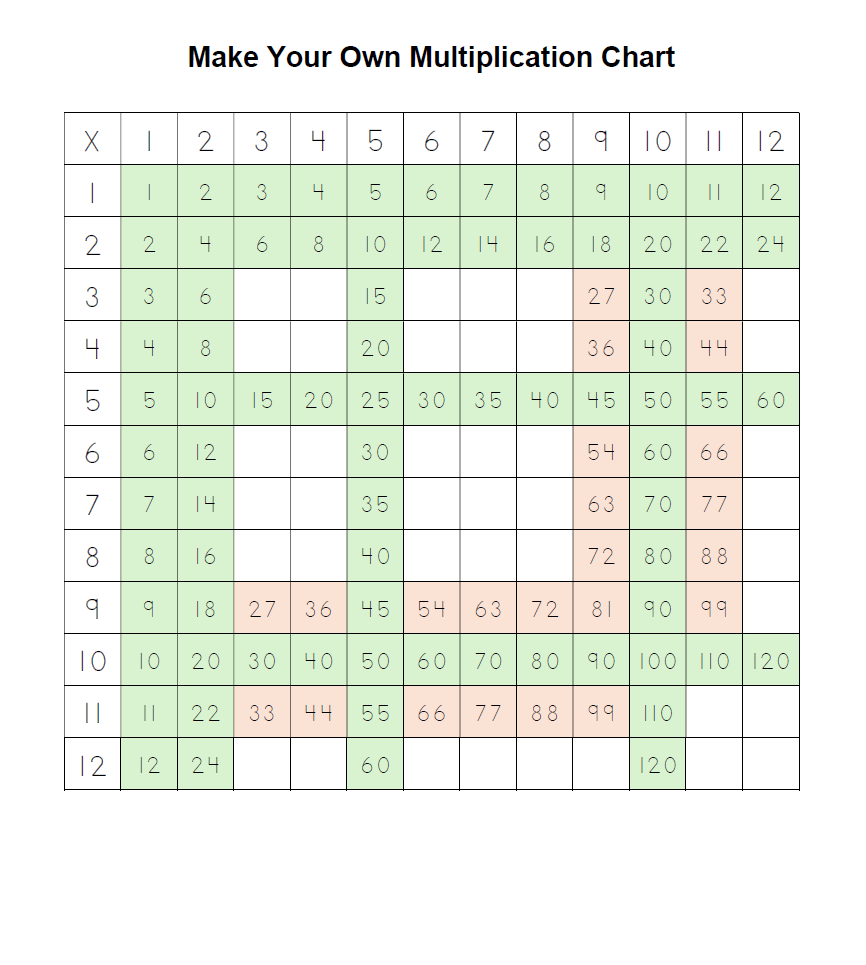
Once you add in the nines and elevens through x 9, your chart will look like this, covering all of the green and orange squares! (You'll have a few more filled in if you included x 11 and x 12 in the elevens facts).
It's Hip to Square Numbers
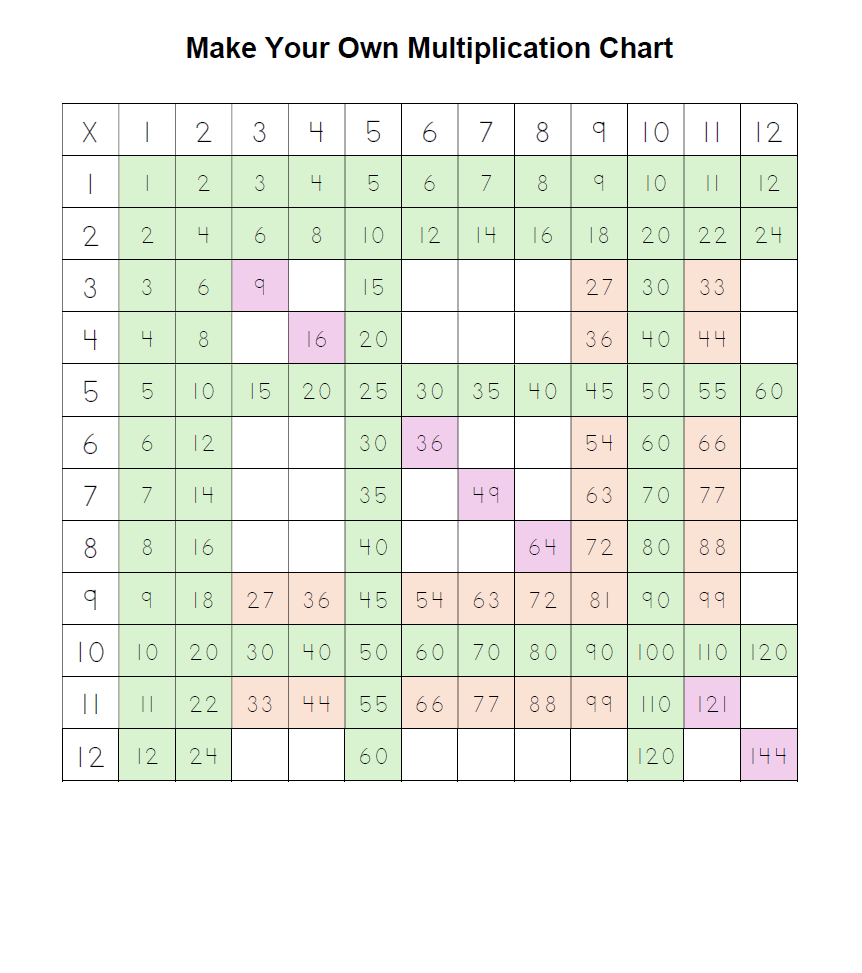
Next, cut a diagonal right through the middle of the multiplication chart by teaching the square numbers. A square number is the result of multiplying a number by itself. For example 7 x 7 = 49 so 49 is a square number. Not only will this fill in squares on your multiplication chart, but being able to identify square numbers will come in handy when your student begins working with the area of squares in geometry and calculating exponents.
Learning the square numbers will fill in the pink boxes.
Skip Counting by 3s and 4s
I love teaching skip counting for all of the numbers through nines as a great introduction to multiplication. But if your students haven't had experience with skip counting, teaching your students to count by threes and fours is the next step to completing your multiplication chart.
Way on back, I purchase the Skip Count Kid CD. You can still listen to it on Amazon Music. You can also search YouTube or Spotify for skip-counting songs. There are lots of options, depending on how well you can stomach kid-song cringe!
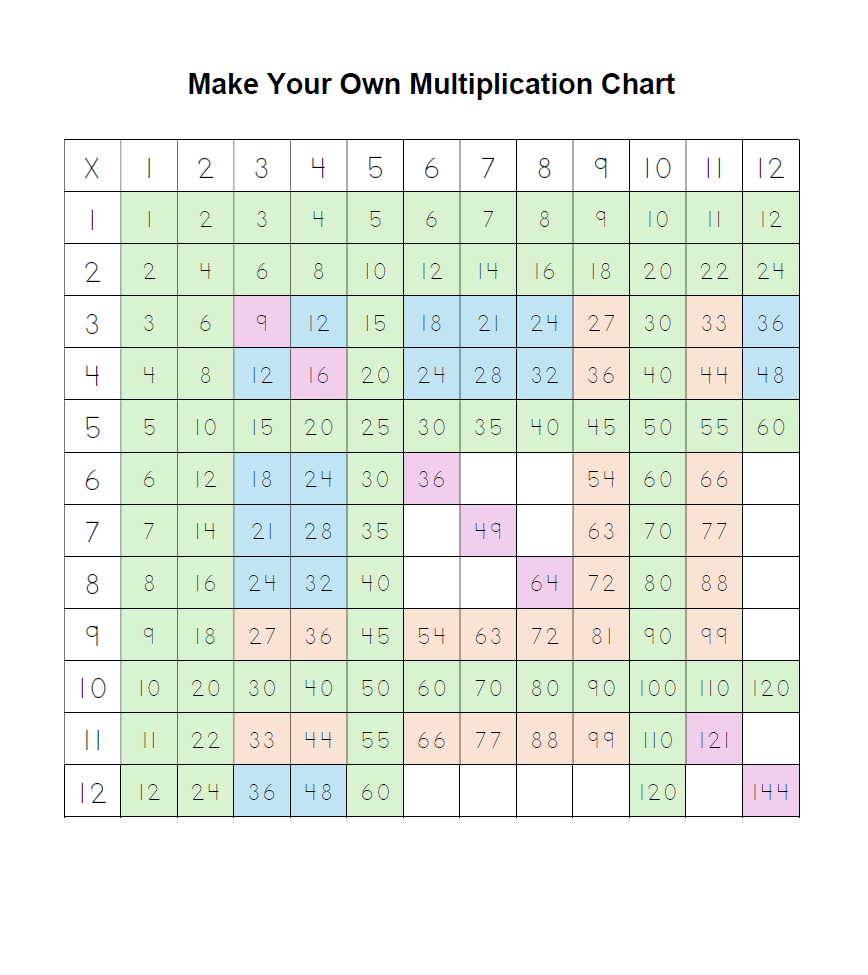
Once you add in the x 3 and x 4 facts (the blue squares), look how far you've come!
A Dozen Eggs, a Dozen Hours
Thinking in sets of twelve is helpful when you are counting dozens of eggs and doughnuts. But twelve is also an important number in telling time. Sets of days or parts of days are sometimes referred to as 24, 36, 48 or 72 hours.
We you looked at the pattern for adding elevens, you showed your students that the tens place and ones place each increased by one. When adding twelves, it's like skip counting by tens and twos at the same time. The tens place increases by one and the ones place increases by two each time.
Now we've added the yellow squares to our multiplication chart and we're almost done!

The Facts Even Adults Always Forget
When you look at the multiplication chart above, you may think you have only six problems left to learn. But the truth is, you only have three!
The Commutative Property of Multiplication
Whether or not you've used the official term with your kids, you've probably already taught them about the Commutative Property of multiplication (and addition, for that matter). When you are adding or multiplying, you can change the order of the numbers you are adding or multiplying and the answer will still be the same.
3 + 5 = 85 + 3 = 8
6 x 4 = 244 x 6 = 24
So the last six boxes on the multiplication chart are really just three last multiplication problems in commutative pairs. And they are the ones I usually forget as an adult!
6 x 7 = 7 x 6 = 42
6 x 8 = 8 x 6 = 48
7 x 8 = 8 x 7 = 56

You can certainly make your own blank multiplication chart in your favorite word processing software, or you can download one here. This set includes one completed multiplication chart and one blank copy for your students to fill in.